FUN WITH MATHEMATICS : NETWORK MODEL GAMES
LEVEL 2: Exploring the networks we live in
Required mathematical skills: understanding of basic mathematical operations
SCENARIO 1
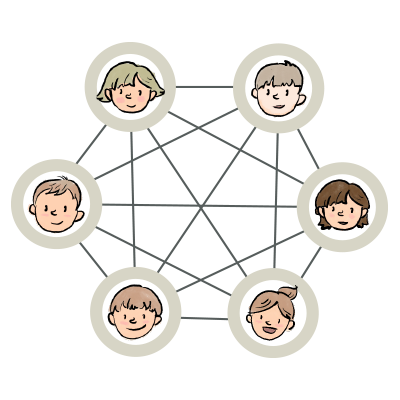
A SMALL, CLOSELY CONNECTED GROUP
INTERACTIVE ONLINE GAME
1
2
3
4
5
6
7
SCENARIO 2
EXPLOITING CLOSELY CONNECTED GROUPS
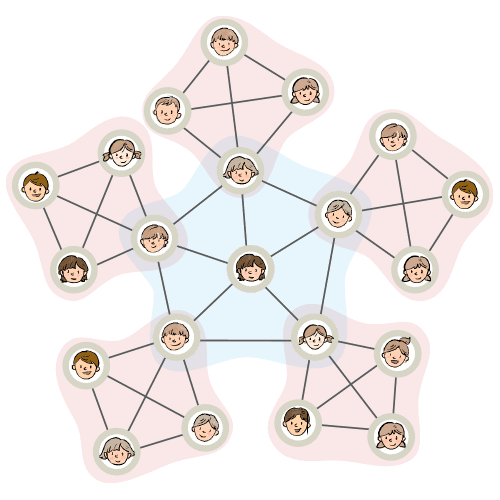
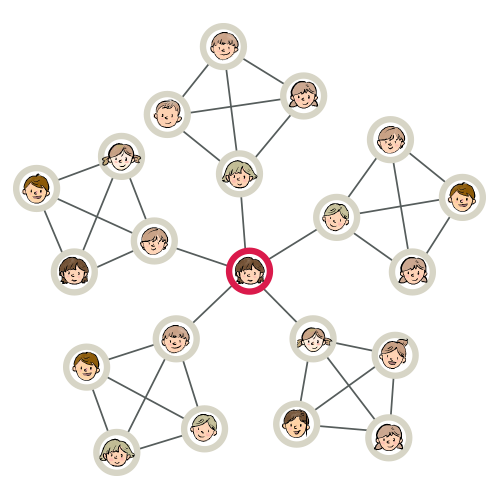
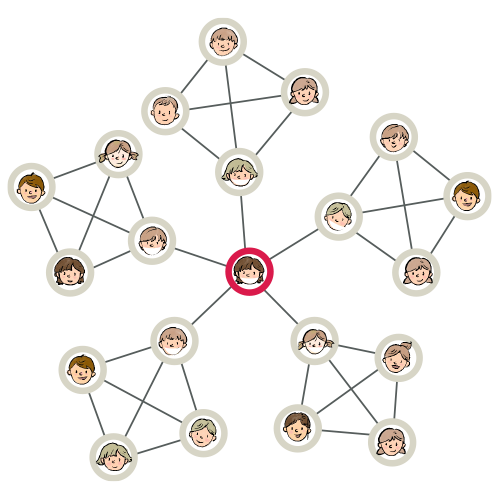
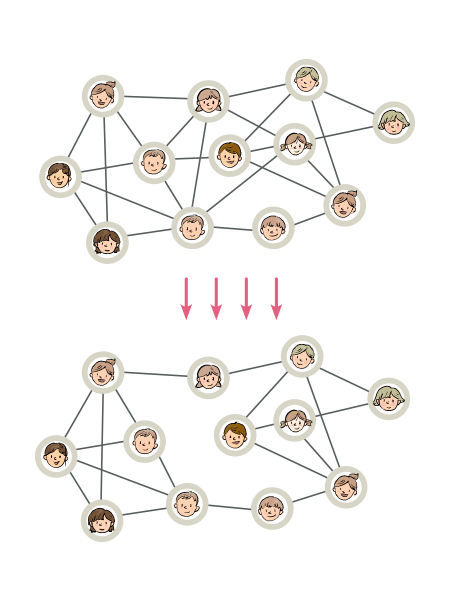
In our daily life we move from one closely connected group to another. For example: we spend a part of our day in a classroom, and another part at home with our family members. This results in a network where one complete graph (i.e., kids in classroom) is connected with other separate complete graphs (families at home).
In this scenario we explore how a disease can exploit this characteristic of such closely connected groups and spread quickly through them.
You can play this scenario as an interactive game, but this network is also one of the networks we suggest playing as an indoor activity game.
INTERACTIVE ONLINE GAME
SCENARIO 3
HOW ONE PERSON CAN INFECT MANY OTHERS
INTERACTIVE ONLINE GAME
SCENARIO 4
HOW WE CAN MAKE A DIFFERENCE, PART 1
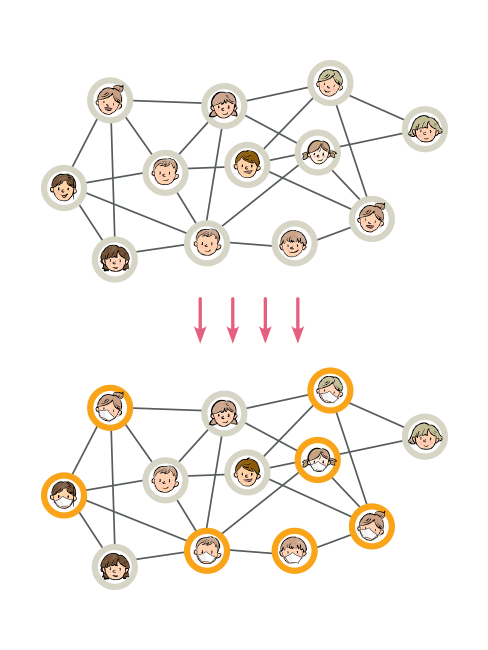
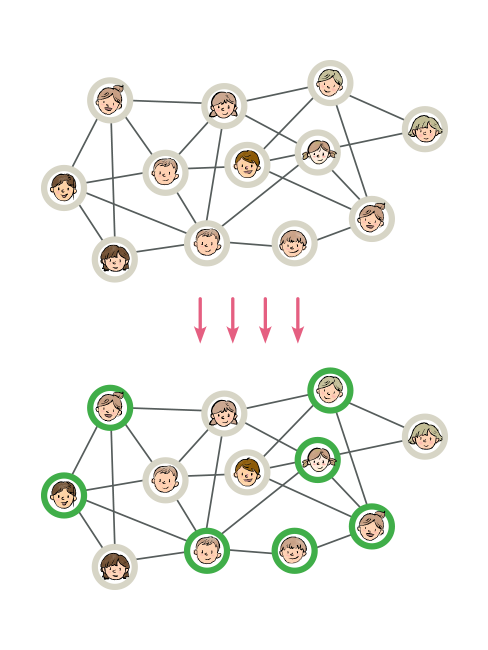
In Scenario 3 we explored a situation when one infected person induces multiple infection clusters by sneezing on a bus, in a restaurant, or at any other similarly crowded place.
However, this scenario could play out quite differently if we do not let sneezed droplets to spread freely from infected person’s mouth/nose. Or if other people do not let those droplets enter their body when inhaling. This can be partially achieved by wearing masks.
In this scenario we replay the situation from Scenario 3, but now the people involved in the first round of virus spreading wear masks.
We treat masks as 50% reduction on the probability of transmitting infection. This means that the base probability set by parameter K drops to K/2 if one person wears a mask during social contact or K/4 if both people in contact wear masks.
INTERACTIVE ONLINE GAME
You can analyze this scenario in comparison with the previous scenario 3. Here is a set of questions that you can try to answer.
Play with the parameter K. Set it to 4 and play the game at least 10 times.
K=4 means that the probability drops to K=2 when during a social contact (represented by an edge between two nodes) wears a mask and to K=1 when both persons wear masks.
Observe the following:
SCENARIO 5
HOW WE CAN MAKE A DIFFERENCE, PART 2
INTERACTIVE ONLINE GAME
BONUS ONLINE GAME
Play the game at least 10 times for each K.
SCENARIO 6
A WAVE OF INFECTION
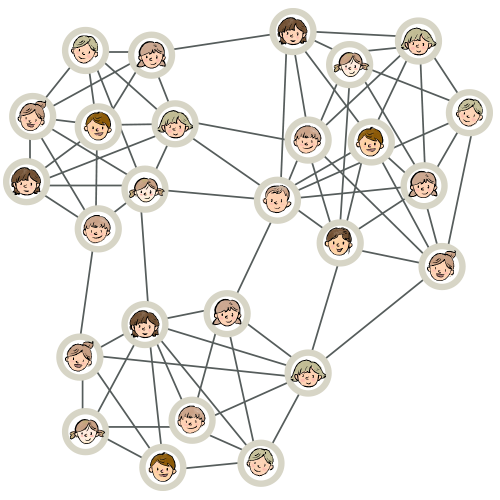
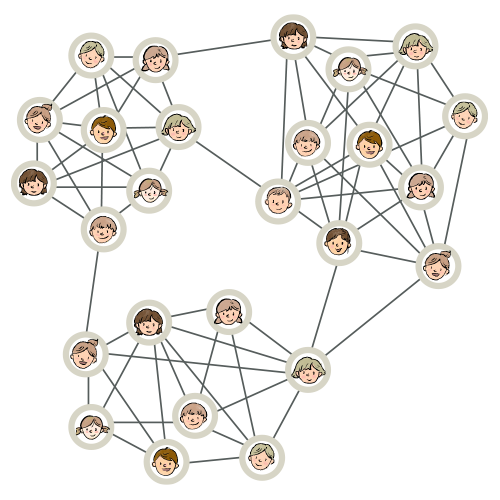
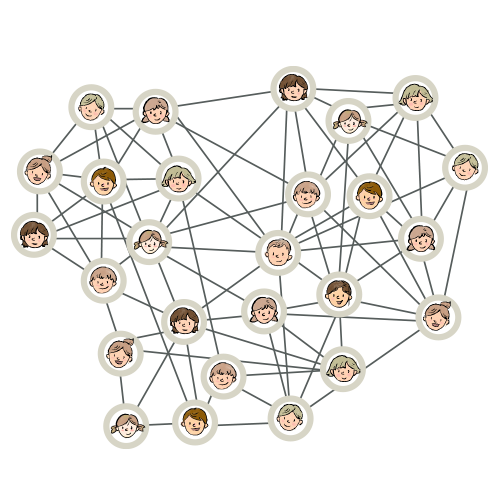
We live in larger social communities than just small closely connected groups. Infectious diseases evolve thanks to the mathematics of disease spread in such larger groups. The survival of a pathogen (virus) depends on its ability to circulate through the population.
In this scenario we look at a disease spread through a larger group of people.
INTERACTIVE ONLINE GAME
SCENARIO 7
SOCIAL DISTANCING
INTERACTIVE ONLINE GAME
SCENARIO 8
WHEN TWO COMMUNITIES MEET
INTERACTIVE ONLINE GAME
SCENARIO 9
A TOWN OF 100 PEOPLE
INTERACTIVE ONLINE GAME
SCENARIO 10
UNMASKING THE MASKS
Wearing masks is recommended as a non-medical public health measure intended to reduce the spread of infectious respiratory diseases like Covid 19. Interestingly, mask wearing became a debated issue. More precisely, the ability of masks to make any difference at all is questioned. The confusion is understandable: masks are far from perfect protection and we know that they do not provide 100% security. So, why do we use them?
In this game set we test the idea that reducing the probability with mask wearing impacts the spread of disease. We use the same network as in scenario 9, but in this one we randomly picked a fraction of nodes and equipped them with masks represented by a small white circle.
We use a simple model to illustrate the mathematics behind masks: when two people meet, the chance of disease transmission between them drops by 50% if one of them wears a mask, and by 75% if both wear masks.
In other words, the probability parameter K is reduced by multiplication by 0.5 or 0.25.

INTERACTIVE ONLINE GAME
Here is a set of questions that you can try to answer.
Play with the parameter K=4 (masks turn this into K/2=2 and K/4=1) and play the game at least 10 times for each K.
Use the same first infected node in all these games. Play scenario 9 games with the very same values of parameter K for comparison.
Observe the following:
SCENARIO 11